Five metals in VEL LEES jewelry: technically, simply
Why metal matters in VEL LEES jewelry
In VEL LEES, the choice of metal is never accidental. In a world where metals in jewelry are more than just a structural material, what matters is color, durability, castability and workability, the way the surface ages, as well as how a given material “carries” symbolism. In practice, this means that in the design process, not only the appearance is taken into account, but also how jewelry made from a specific material will behave in everyday wear.
In the jewelry industry, both precious and non-precious metals have been used since ancient times. The former primarily include gold, silver, and platinum. It is gold, silver, and platinum that are most commonly used in jewelry because they combine aesthetics, durability, and high chemical resistance. However, in practice, other materials are also used, including copper, brass, bronze, stainless steel, and titanium.
It is worth remembering that many metals in their pure form are simply too soft for comfortable use. That is why alloys with other metals and elements are used in jewelry production to increase hardness, improve resistance, and stabilize the structure. Such alloying additions make the material better suited for everyday wear and help it maintain a beautiful shine more easily.
In this sense, metal is not just a “base” for form. It is one of the main protagonists of a jewelry piece. It influences weight, color, metallic shine, ease of forming or greater rigidity, as well as whether a design will feel subtle and cool, or rather warm, luminous, and more expressive.
If you want to see how metals in jewelry combine with intention and symbolism, see the entire VEL LEES collection - Click here.
Copper (Cu)
What it is technically
Copper is a non-ferrous metal with a characteristic warm, pinkish-red color. It is relatively soft, highly malleable, and conducts heat and electricity very well. These properties are what have made it widely used not only in craftsmanship, but also in jewelry making.
In jewelry, copper is valued for its ease of forming and the “living” character of its surface. In its pure form it works very well, but it is also often used as a component of alloys with other elements.
Why it is used in VEL LEES
In VEL LEES, copper appears where the following are important:
- a distinctive, warm color,
- natural patina,
- the character of a metal that changes over time,
- a strong, artisanal feel of form.
Copper works particularly well where jewelry is meant to have something organic and imperfectly “alive” within it.
How it behaves in wear
Copper may darken and develop a patina. This is not a flaw, but a natural process resulting from contact with air, moisture, cosmetics, and sweat. For many people, this variability is part of the material’s charm.
If you want to maintain a lighter tone, it is worth avoiding chemicals, perfumes, and prolonged contact with water.
Esoteric meaning (symbolically)
Symbolically, copper is often associated with conduction, flow, the energy of Venus, beauty, and harmony. For many people, it is a metal “close to the body” and emotions — softer in perception than classic precious metals.
If you feel this direction, see copper-based jewelry – Click here.
Brass (an alloy of copper and zinc)
What it is technically
Brass is an alloy that mainly contains copper and zinc. Depending on the proportions, it can range in color from light gold to a warmer, honey tone. Thanks to its good technological properties, brass is often used in jewelry production and casting.
In practice, this means it takes detail well, is stable in form, and gives an aesthetic golden effect without using pure precious metal.
Why it is used in VEL LEES
In VEL LEES, brass is used where the following are important:
- precision of casting,
- clarity of form,
- a golden tone,
- visual consistency with gold-plated elements.
How it behaves in wear
Brass may slightly darken over time. Jewelry made of brass is sometimes coated with protective layers or lacquer to increase corrosion resistance and slow down surface changes.
In everyday use, it is best to protect it from water, sweat, and strong chemicals.
Esoteric meaning (symbolically)
Symbolically, brass is often associated with the sun, agency, courage, and presence. It carries the warmth of gold, but in a more artisanal, earthy form.
Bronze (most often an alloy of copper and tin)
What it is technically
Bronze is a classic metal alloy, most commonly made of copper and tin, although it may also contain small amounts of other elements. It is valued for its durability, stability, and good casting performance.
It is a material that has been used for centuries in the production of functional and decorative objects, and today it still finds its place in jewelry.
Why it is used in VEL LEES
Bronze works well as a base for cast elements. In VEL LEES, it can serve as a foundation for cooler finishes, for example when aiming for an effect similar to silver or platinum.
How it behaves in wear
Bronze itself is stable, but when it comes with a coating, care becomes crucial. In such cases, it is worth avoiding friction, swimming pools, salt, perfumes, and aggressive cleaning agents.
Esoteric meaning (symbolically)
Symbolically, bronze is often associated with grounding, stability, memory of form, and durability. For many people, it has a more “earthy” character than silver or gold.

Gold 585 (14K)
What it is technically
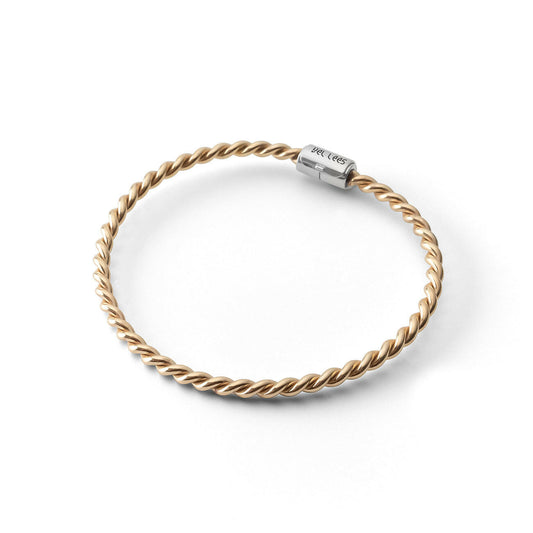
585 gold means that the alloy contains 58.5% pure gold, and the rest consists of other metals. In Poland, this is the most popular gold purity used in jewelry. In practice, this means that out of 1000 units of mass, 585 units are pure gold.
Pure gold is 24-karat gold, meaning a material containing 100% gold. However, in its pure form, it is too soft for everyday wear. That is why gold jewelry is made using alloys with other metals to increase hardness and improve durability.
In its pure form, gold has a golden-yellow color, a strong shine, and is the most malleable of all metals. It is this property that has made it so desirable for centuries.
Why it is used in VEL LEES
In VEL LEES, 585 gold appears where the following are important:
- lasting value,
- nobility of the material,
- elegance, prestige,
- a material “for years”.
How it behaves in wear
Compared to pure gold, 585 alloy is much more practical. Thanks to the addition of other metals, it has increased hardness, making it more suitable for everyday use.
It can get scratched like any precious metal, but it is not a demanding material. It withstands regular wear well if properly cared for.
Shades and alloys
Depending on alloying additions, gold can have different shades. White gold is not obtained “naturally,” but by combining gold with other metals, such as palladium. Higher-karat gold such as 14K, 18K, and above contains fewer added metals than lower-purity alloys, which for many people also matters in terms of wearing comfort.
Esoteric meaning (symbolically)
Since ancient times, gold has been associated with light, power, abundance, and authority. Symbolically, it can be treated as the metal of decision, the center of attention, and inner radiance.
In VEL LEES collections, gold appears where durability and a symbolic “seal of decision” matter.
Silver 925 (sterling)
What it is technically
925 silver contains 92.5% pure silver and 7.5% other metals, most often copper. Pure 999 silver is too soft for everyday wear, which is why alloys are used in jewelry making.
Silver is a silvery-white metal with a beautiful shine and has been used for centuries to create jewelry and ornaments. In its pure form, it is sometimes referred to as native silver, but 925 alloy works best in everyday use.
Why it is used in VEL LEES
In VEL LEES, 925 silver is chosen where the following are important:
- a cool, elegant tone,
- minimalist aesthetics,
- the classic of a precious metal,
- purity of form.
How it behaves in wear
Silver may darken. This process is oxidation, a natural darkening of silver due to contact with air and the environment. Oxidation can also be induced chemically if the design requires a specific visual effect and more pronounced details.
Silver jewelry may develop tarnish over time, but it can usually be easily refreshed with a soft silver cloth or by a jeweler.
Rhodium-plated 925 silver creates an additional protective layer between the skin and the metal, providing greater surface resistance and helping to limit darkening.
Esoteric meaning (symbolically)
Silver is often associated with the moon, intuition, sensitivity, inner silence, and subtle protection. For many people, it is a more reflective, cooler, and more “inner” metal than gold.
Hallmarks and metal purities in jewelry
Hallmarks are extremely important in jewelry. These are official markings that confirm the content of precious metal and its purity. Hallmarking is carried out by an Assay Office.
Hallmarks are official marks stamped on a piece. In practice, this means that the jewelry has been tested for quality and metal content in the alloy. This is important for both the manufacturer and the customer.
In marking jewelry, not only the purity number matters, but also the symbol. The hallmark contains a symbol of the metal, which helps identify the material. In the Polish hallmarking system, you may encounter markings such as:
- a horse’s head indicating gold jewelry,
- a dog’s head indicating silver jewelry.
In the case of gold and silver, the content of precious metal is expressed in thousandths. The higher the purity, the higher the nobility and value of the product.
Precious metals and non-precious metals - what is the difference
Not all metals used in jewelry have the same material status. Precious metals primarily include gold, silver, and platinum. They are characterized by high durability, high chemical resistance, and lower reactivity.
In simple terms, precious metals do not corrode as easily as other materials because they react less with water and many external factors. They are also characterized by high chemical resistance to most substances, although each metal has its own specifics.
Non-precious metals include copper, brass, and some alloys used in jewelry bases. This does not mean they are “worse” — they simply age differently, have different properties, and require slightly different care.
Platinum, palladium, iridium, ruthenium, and rhodium - a few important jewelry materials
Although this article focuses on five metals used in VEL LEES, it is worth knowing a few other materials that are important in jewelry.
Platinum is one of the most valuable precious metals found in nature. It has high density, is very hard, heavy, and durable. This is why it is especially used in diamond settings and high-durability jewelry. Pure platinum is not very common in everyday jewelry, as like other metals, it is usually used in alloys.
The platinum group also includes palladium, iridium, ruthenium, and rhodium. Rhodium and ruthenium are especially used in surface finishes. Rhodium plating improves color and protects the metal from oxidation, while palladium is used, for example, in creating white gold.
Hypoallergenic properties of metals and skin contact
For many people, it is important not only how a metal looks, but also how it behaves in contact with the skin. The most common metal allergen is nickel. That is why eliminating nickel in hypoallergenic jewelry is important for wearing comfort.
In modern jewelry, safer choices include:
- 925 silver,
- higher-purity gold,
- platinum,
- 316L stainless steel,
- titanium.
316L stainless steel is harder than silver, corrosion-resistant, and widely used in modern jewelry.
Titanium is very light, extremely durable, and for many people one of the safest choices for very sensitive skin.
How to choose a metal for yourself (practically, without overthinking)
If you want to approach the choice practically, you can think about it like this:
- you want warmth, a living character, and a material that ages with you → copper
- you like golden tones and clear detail → brass
- you choose cool minimalism → 925 silver
- you are looking for a material with prestige and lasting value → 585 gold
- you care about weight, durability, and top-tier classic quality → platinum
In practice, this means there is no single “best” metal. There are simply different properties, different aesthetics, and different needs.
You can approach the choice of metal intuitively - or see which forms and materials resonate with you most in practice - Click here.
Simple care that makes a difference
Care really affects how metal looks over time. Regardless of whether you wear gold, silver, or brass:
- remove jewelry for bathing, swimming, sauna, and workouts,
- avoid contact with strong chemicals and perfumes,
- wipe it with a soft cloth after wearing,
- store jewelry in a dry, cool place, preferably in a box or pouch,
- use a soft cloth designed for jewelry cleaning to avoid scratches.
This is especially important for silver, which may darken, and for protective coatings that do not tolerate friction and chemicals.
Precious metals beyond jewelry
It is also worth adding another context: precious metals are commonly associated with jewelry, but they also exist as investment products. Gold and silver are often chosen not only for jewelry, but also for storing value in the form of coins or bars.
For many people, this is an important cultural background: the value of gold and silver has been recognized for centuries, and in times of economic uncertainty, the topic of their durability and symbolic security often returns.
In VEL LEES, however, we do not view metal solely as a store of value. Here, it remains above all a carrier of form, aesthetics, symbol, and everyday meaning.